Educational flashcards will enable kids to recognize the alphabet, numerals, words, and basic ideas by means of pictures and brief questions. They can easily be practiced both at home and in classrooms, as well as be tailored to suit a particular kid’s abilities.
Whether or not flashcards can be used successfully depends on how they are used. Some of the ways of making learning interesting include having short practice exercises, constant revisiting of the learned information, and playing games. Flashcards for those learning a second language can be used alongside audio devices.
1. Why Are Educational Flash Cards Effective for Learning?
The information is communicated to the children bit by bit through educational flashcards. The children are not required to remember several concepts at once but focus on one word, number, or picture.
- Visual Recognition: Images, colors, and letters help in recognizing an object visually and relating it to the words.
- Active Recall: Asking the children to guess the names of the objects before showing them assists in recalling information.
- Revision: Reviewing difficult flashcards allows the children to increase their knowledge.
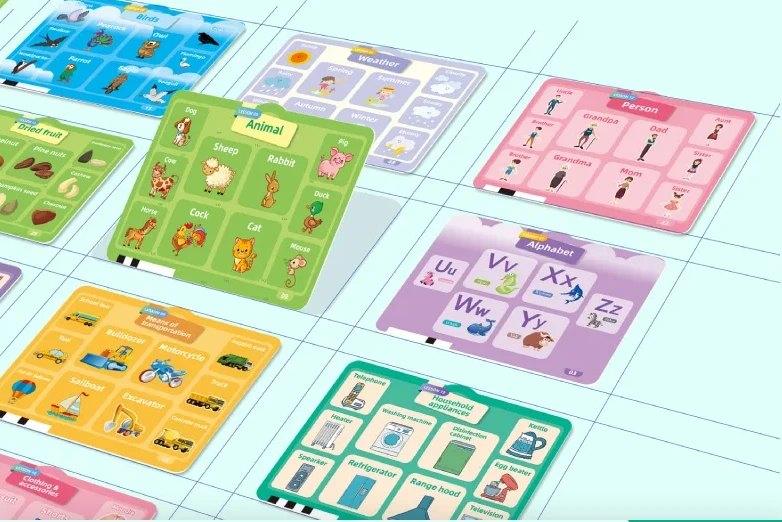
- Concept Classification: Categorizing the flashcards into different groups such as animals, fruits, and cars helps the children distinguish between them.
Active Recall: Physical manipulation of the flashcards through rotation and sorting makes the children more active in the process of learning.
2. How to Use Educational Flash Cards Step by Step
A clear routine makes practice easier to manage. Start with familiar topics and introduce more challenging material as the child becomes comfortable.
Simple and Familiar Subjects First
Select topics that children will meet in their daily lives, like different fruits, animals, colors, or objects from home.
Begin the lesson with about 5-10 flashcards at a time. It is not necessarily a rule, but a good starting point since some children may require fewer Education flashcards in the beginning.
Ask Questions and Not Show Answers
Present an Education flashcard and ask the child, “What is this?” or “What letter starts this word?”
For language practice, children can identify the object on the card, say the word, and then pronounce it correctly. In this way, the simple recognition exercises become speaking exercises too.
Repetition and Revision of Previously Taught Lessons
Do not change all flashcards within a single lesson, but use both new and familiar flashcards in one lesson.
Therefore, a class of 10 Education flashcards will include 4 new words and 6 already learned words. Repetition of difficult cards for kids should be done more frequently than other cards, and vice versa.
Turning Flash Cards into Fun Games
Any kind of simple game will help to avoid monotonous learning:
• Picture-Matching Game: The children have to match the picture with the word.
• Find the Card Game: The children should find the object based on the short description.
• Sorting Game: The educational flashcards should be sorted by color, category, size, and purpose.
• Memory Game: Allow the children to see some flashcards, hide them, and try to remember them.
Any kind of game lasting 5-10 minutes can be a perfect start for your lesson. The time of the game should depend on the child’s attention, not on a definite time.
3. How to Combine Educational Flash Cards with Audio Devices for Better Learning
Printed educational flashcards mainly rely on visual information and spoken questions from a parent or teacher. Audio devices add another way to explore the same content, particularly when children are learning pronunciation, listening, or bilingual vocabulary.
Combine OID-Coded Education flashcards with a Reading Pen
The OID (Optical Identification) technology has the potential to link a printed code with specific audio recordings, where the code will be identified by the reader, and a corresponding word, sentence, or sound will be played.
For instance, an animal card will include a picture of a tiger with its English name below. A child scans the code, listens to the pronunciation, and repeats the word. In order to make such a connection, the code, the reading device, and the audio recording must be compatible.
Use an Insert-Card Voice Player for Easy Audio Learning
There is a second type of devices that use a slightly different mechanism. The child selects a specific card, holds it in a particular way, and listens to the audio for that card.
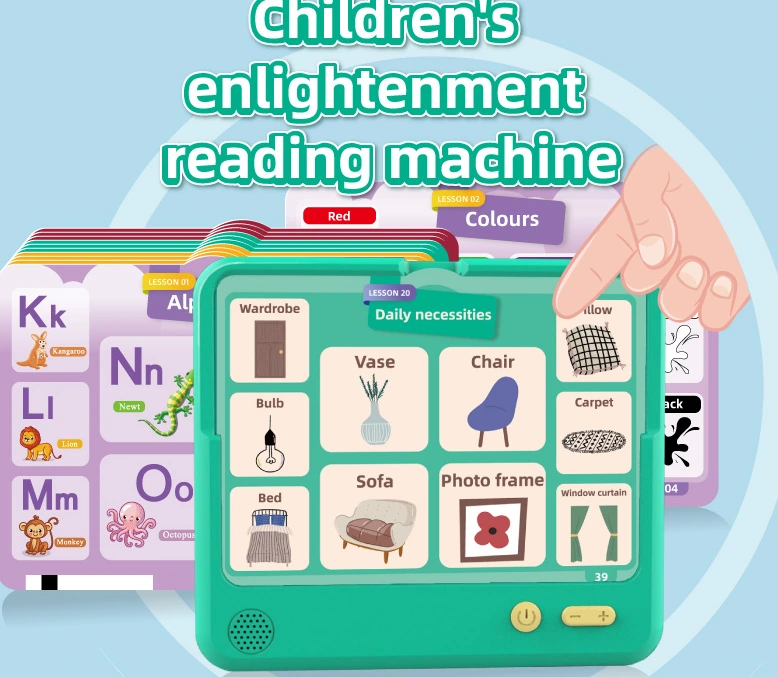
For instance, Smart Tomato’s DD-01 Enlightenment Reading Machine, designed for children between 3 and 8 years old, offers children the choice of learning without a screen through card-based learning that includes 50 learning cards that have 18 modules of knowledge, including letters, numbers, fruits, vegetables, animals, necessities, body, and shapes. The gadget enables you to learn both English and Chinese pronunciation using audio containing pronunciations of words, simple sentences, and even questions.
How Is Audio Useful for Interactive Learning from Educational Flash Cards?
Through audio, children have the possibility to listen to the word instead of just reading it. They can listen, repeat, and understand whether their pronunciation is correct or not by checking the picture.
Audio becomes really helpful in cases when children interact with what they listen. In other words, parents should not just let the audio run; they need to get children to repeat a word, explain a picture, or answer a question.
4. How to Choose the Right Educational Flash Cards for Different Learning Needs
The right educational flashcards depend upon the age of the child, his/her skills, goals, and practice preferences. Flash cards with more material do not automatically become more helpful if they are too hard or monotonous.
Content and Age Group Correspondence
Young children might enjoy pictures of familiar objects, colors, and geometric shapes. Children with better foundational knowledge will be able to learn phonics, vocabulary, and math.
Evaluate the Visual Elements
Select visual elements that consist of recognizable pictures, easy-to-read text, and designs focused on one key idea at a time.
Audio Features
Traditional Education flashcards will be appropriate for picture recognition and categorization. Flashcards with reading pens and audio players will be suitable when developing listening and pronunciation are the goals.
Compatibility Check
Ensure compatibility between coded cards, reading pens, and audio players before purchasing any material.
Durable Flashcards
Educational flashcards should be robust enough to survive constant use by kids who should also be able to handle them comfortably while sorting and storing.
Room for Growth
The Education flashcards chosen should allow for various levels of usage as a learner evolves from picture recognition through word recognition to question answering.
Parents don’t necessarily need to introduce all of the flashcards available at once. A selected amount of cards based on a learner’s current proficiency will be more effective than a bigger variety of them.
Conclusion
Educational flashcards are useful for vocabulary development, early literacy, numbers, and concept development. What makes flashcards valuable for children is the way in which they answer questions, review challenging concepts, and put their learning into practice using games. In addition to traditional flashcards, audio flashcards are also available for language activities that involve picture association with pronunciation and listening activities. The best way is to select appropriate material, limit the duration of the session, and provide opportunities for children to respond.
If you are looking for interactive learning products that will help your child learn interactively, Smart Tomato provides solutions. You can contact Smart Tomato for further inquiries regarding the product and its learning abilities.